

When people ask me what approach I’ve found most effective in my homeschooling journey, I can honestly say it come down to two things:
- Prioritizing my relationship with my kids and meeting them where they are.
- Doing little things intentionally and consistently over time, instead of pushing and forcing big, elaborate plans all at once.
This classic stories reading challenge grows out of that philosophy.
It’s not about doing more. It’s about creating space for meaningful moments with stories. You can implement this slowly, gently, and in ways that actually last.
Table of Contents
ToggleClassic Stories Reading Challenge
There’s a quiet pressure that can creep into reading challenges.
A sense that you should be doing more. That reading classics needs to look a certain way. That if you aren’t squeezing every drop of “educational value” out of a book, you’re somehow doing it wrong.
This challenge is an invitation to let all of that go.
The Gentle 12-Month Classic Stories Reading Challenge isn’t about racing through a list or turning every story into a lesson plan. It’s about building a slow, meaningful relationship with classic stories. You can do this one month at a time, in ways that actually fit real families.
No checklists to conquer. No guilt for falling behind.
Just permission, curiosity, and a little consistency.
What Makes This a Gentle Reading Challenge?
This classic stories reading challenge is intentionally open-ended. Instead of prescribing what you must read each month, it focuses on how you approach reading classics.
A little every month counts. And it adds up more than you think.
One chapter. One short story. One audiobook on a long drive. One picture-book version of a classic tale.
All of it counts
Over 12 months, those small moments quietly shape familiarity, confidence, and comfort with classic literature.
Reading Permissions (You're Allowed to...)
Let’s start with something we don’t talk about often enough: permission.
You Can Just Enjoy the Story
You do not have to turn every classic into a lesson. This is an introduction, an invitation, a first experience.
You’re allowed to:
- Read without stopping for vocabulary
- Skip comprehension questions
- Laugh, wonder, or simply listen
Sometimes the most powerful thing a story does is create a shared experience.
You Can Just Read One Chapter
You don’t have to finish every book you start.
You might:
- Read one chapter aloud as an introduction
- Leave the book on a shelf afterward
- Discover months later that your child picked it up on their own
Curiosity has a long memory.
You Can Drop a Book
If your family isn’t enjoying a story, you’re allowed to stop.
There are:
- Many classics in the world
- Many seasons of life
- Many versions of readiness.
Not every story is for every reader. And that’s okay.
You might return to it in a year or two and have a completely different experience.
You Can Go Slowly
This is not a sprint.
A chapter a week. A short story this month. Life got in the way last month, but you picked it up again this month.
All of it still counts.
How-Tos (Without Overcomplicating it)
If you like a little structure, but not too much, here are some gentle ways to approach classic stories.
Read Aloud as an Invitation
Reading aloud lowers the barrier to entry. It allows children to:
- Hear rich language without decoding it
- Absorb story structure naturally
- Experience classics before they’re ready to read them independently
You’re planting seeds, not assigning work.
Use Multiple Formats
Classics don’t only live in heavy hardcovers.
They can show up as:
- Audiobooks
- Illustrated editions
- Retellings
- Short excerpts
Different formats still build familiarity with timeless stories.
Let Interest Lead
If a child loves animals, adventure, mystery, or friendship, lean into that.
You don’t need to force a specific title to make progress.
Interest is often the doorway.
The 12-Month Mindset: Small Steps, Real Impact
Instead of thinking:
“We need to read 12 classics this year.”
Try:
“We’ll make space for classic stories throughout the year.”
One story a month (or even part of a story!) creates rhythm without pressure.
By the end of the year, you may notice:
- Greater comfort with longer stories
- Familiarity with older language
- A growing sense that classics are approachable
Not because you pushed, but because you stayed.
An Open-Ended Challenge (Not a Rigid List)
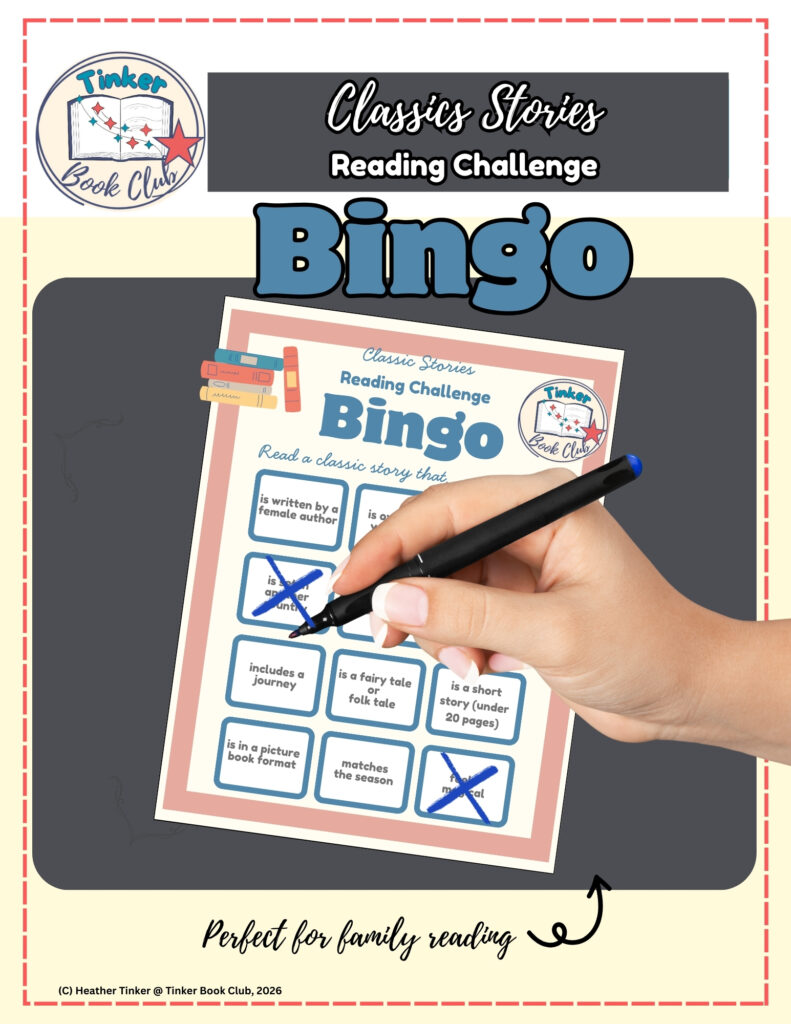
To support this gentle approach, the free companion resource to this post is an open-ended Classic Stories Bingo Board.
Instead of specific titles, the prompts invite exploration:
- Read a classic written by a female author
- Read a story that’s over 100 years old
- Read a classic story with animals
- Read a classic set in another country
You choose the stories. You create the pace. The bingo board is meant to spark ideas, not dictate outcomes.
A Final Encouragement
Classic stories have lasted because they speak to something timeless. But they don’t need to be approached in rigid ways.
Gentle exposure matters.
Shared moments matter.
And giving yourself permission to read in ways that work for your family now matters most of all.
If all you do this year is read a little more slowly, a little more freely, and a little more joyfully, then you’ve already succeeded.
Get the Free Classic Stories Bingo Board
If this gentle approach to classic literature resonates with you, I’d love to support you further.
When you join my email list, you’ll receive:
- The free open-ended Classic Stories Bingo Board
- Encouragement for slow, relationship-centered learning
- Simple ideas for enjoying classic stories without pressure or overwhelm
This is for families who want reading to feel meaningful, not forced.
Sign up below 👇 to get the free Classic Stories Bingo Board and join the Tinker Book Club community.
If you enjoyed this post, you might also like 👉 Why Classic Stories Still Matter for Today’s Kids.
Thanks for listening, friends!