


If you’ve reset your homeschool reading routine more times than you can count (especially after the holidays!), you’re not alone.
You start with the best intentions. A fresh plan. A stack of beautiful books. Maybe even a new schedule taped to the fridge. And for a few days (or weeks), it works.
Then real life shows up.
Someone gets sick. The weather shifts. Energy dips. Your child resists. You fall behind. And suddenly, it feels like your reading routine had fallen apart again.
The truth is that most homeschool reading routines are build to be followed, not lived in.
So instead of trying to “fix” your routine yet again, let’s try something different.
Table of Contents
ToggleStop Rebuilding the Routine. Build a Rythm Instead.
Traditional routines rely on consistency, predictability, and ideal conditions. Rhythms, on the other hand, are designed to bend.
A reading rhythm doesn’t ask, “Did we read at 9:00 am every day?” It asks, “Where does reading naturally fit into our days right now?”
Rhythms are anchored moments, not minutes.
This small shift, from routine to rhythm, is often what allows reading to finally become sustainable in real homeschool life.
Start With One Reading Anchor
If your reading routine keeps falling apart, it’s usually because there are too many moving parts.
Instead of planning reading for multiple subjects, time slots, or formats, choose one anchor. Just one.
Some gentle options:
- A short read-aloud during breakfast or lunch
- Cozy afternoon reading with tea or snacks
- Bedtime family reading
- A few minutes of poetry during morning time
This anchor becomes your home base. If nothing else happens that day, reading still happened.
And if even that feels like too much? Start with three days a week. Consistency grows from success, not pressure.
Stack Reading Onto What You're Already Doing
One reason reading routines struggle is because we try to add reading instead of attaching it to something that already exists.
Look for natural pairings:
- Reading aloud while kids eat or draw
- Audiobooks during quiet play or rest time
- Short stories while waiting for siblings
- Poetry as a transition between subjects
- When reading becomes part of something familiar, it stops feeling like another box to check.
Use Short, Complete Texts to Rebuild Momentum
After a break, or during a season of low energy, chapter books can feel heavy. This is where classic short stories, folk tales, and poems shine.
They offer:
- A sense of completion
- Less pressure to “keep up”
- Rich language without long-term commitment
Finishing something matters. It builds confidence for both you and your child and reminds everyone that reading can feel satisfying, not stressful.

Rotate Variety to Prevent Burnout
Another reason routines fall apart? Monotony.
Instead of sticking to one format, gently rotate:
Variety keeps interest high without requiring more planning. And it helps meet children where they are developmentally and emotionally.
Let a Framework Hold the Weight (So You Don't Have to)
If planning is the piece that keeps derailing your reading routine, this is where a low-pressure framework can help.
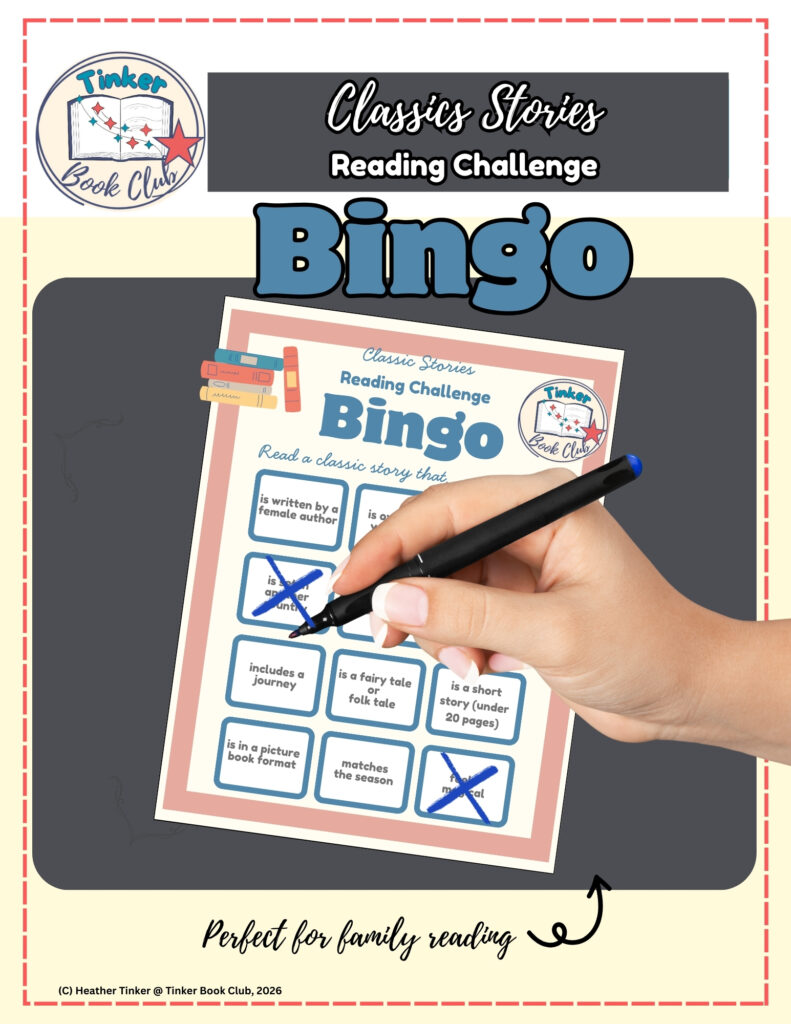
A simple challenge or bingo-style guide offers:
Built-in variety
Choice and flexibility
Direction without rigidity
Rather than deciding what to read each day, you’re simply choosing the next square. Or maybe even just following curiosity when it shows up.
The goal isn’t to finish everything.
The goal is to keep reading gently, consistently, and joyfully.
Look for the Signs That it's Working (Even When it's Messy)
A sustainable reading rhythm doesn’t look perfect.
It looks like:
- Your child asking for “just one more story”
- Reading happening in short, or uneven bursts
- Skipped days followed by easy restarts
- Books becoming familiar and comforting again
If reading keeps finding its way back into your days (even imperfectly) that’s success.
A Gentle Reminder
You don’t need a better plan.
You don’t need more discipline.
There’s no need to start over. Again.
You need a reading approach that honors your season, your child’s energy, and the reality of homeschool life.
When reading is built around rhythm, relationship, and flexibility, it stops falling apart and starts becoming part of who your family is.
Ready for a Gently Way to Support Your Reading Rhythm?
If you’d like a simple, flexible way to bring classic stories back into your homeschool without pressure, the Classic Stories Reading Challenge was created to support exactly this kind of reading life.
It’s designed to meet you where you are and help reading feel doable again.
When you join my email list, you’ll receive:
- The free open-ended Classic Stories Bingo Board
- Encouragement for slow, relationship-centered learning
- Simple ideas for enjoying classic stories without pressure or overwhelm
Sign up below 👇 to get the free Classic Stories Bingo Board and join the Tinker Book Club community.
If you enjoyed this post, you might also like 👉 A Gentle 12 Month Classic Stories Reading Challenge.
Thanks for listening, friends!