


If you search online for ideas for a kids book club, you’ll often find elaborate party plans, themed crafts, printable worksheets, and complicated activities.
And while those things can certainly be fun (I absolutely LOVE a cute craft or creative snacks), they aren’t what make a book club meaningful.
At its heart, a great kids book club is built on something much simpler and much more powerful: shared stories, thoughtful narration, and conversations that invite children to wonder.
When homeschool families gather children around classic books, the goal isn’t to complete assignments. It’s to help young readers experience literature. And hopefully learn to love it through moments of connection and togetherness.
Three simple practices make this possible: narration, wonder questions, and imagination.
Table of Contents
ToggleWhy Conversation Is the Heart of a Kids Book Club
The most memorable part of any kids book club isn’t the snack table or the activity. It’s the moment when children start talking about the story.
When kids are given space to share ideas, retell events, and explore questions together, they begin to see books as something worth thinking about long after the reading ends.
This is especially true when reading classic children’s literature. Timeless stories invite reflection rather than rushing toward quick answers.
A well-run kids book club allows children to:
- Listen closely to stories
- Share their interpretations
- Practice expressing ideas
- Discover that books can spark meaningful conversation
And that’s where narration naturally comes in.
Narration: The Foundation of a Thoughtful Kids Book Club
Narration is one of the simplest and most powerful tools in a homeschool book club.
After a story is read, children are invited to retell the story in their own words. There are no scripts, worksheets, or right answers. Just the child’s natural response to what they heard.
In a kids book club, narration might look like:
- Retelling the story (or episode in the story) from memory
- Explaining what happened first, next, and last
- Describing a favorite moment
- Acting out part of the story
- Drawing a scene and explaining it
Narration does several important things at once.
It helps children:
- Process the story deeply
- Strengthen comprehension
- Build confidence in expressing ideas
Most importantly, narration gives every child a voice within the book club conversation.
Wonder Questions: Opening the Door to Meaningful Discussion
Once children have had the chance to narrate, the next step in a thriving kids book club is asking the right kind of questions.
Traditional comprehension questions often lead to short, predictable answers. Wonder questions, on the other hand, invite reflection.
Instead of asking what children remember, wonder questions ask what they think.
Some examples include:
- What part of the story stayed with you the most?
- Which character did you understand best?
- Why do you think the author included this moment?
- What do you think the story is really about?
- Does the story remind you of anything?
The goal isn’t to lead children toward one “correct” interpretation. The goal is to help them think more deeply about the story and hear how others experienced it.
This is when a kids book club truly comes alive.
Imagination: The Hidden Power of a Kids Book Club
Stories naturally awaken imagination.
When children read fairy tales, fantasy, or classic adventure stories, they are entering worlds that require then to visualize, interpret, and empathize.
A kids book club that prioritizes imagination allows children to:
- Picture scenes vividly
- Step into the perspective of different characters
- Consider choices and consequences
- Explore ideas like courage, kindness, and sacrifice
- Imagination is not separate from learning. It is central to it.
Through imaginative engagement, children begin to internalize the deeper meanings within stories.
A Simple Rhythm for a Kids Book Club
The beauty of this approach is that it doesn’t require complicated planning. A meaningful kids book club can follow a simple, repeatable rhythm.
1. Read the Story
Read aloud together or assign reading ahead of time, depending on the age of the group.
2. Invite Narration
Allow children to retell the story in their own words before moving into discussion.
3. Ask Wonder Questions
Encourage open-ended conversation rather than short answers.
4. Let Imagination Do Its Work
Children may draw scenes, act out moments, or simply continue thinking about the story afterward.
This rhythm keeps the focus on literature rather than busywork.
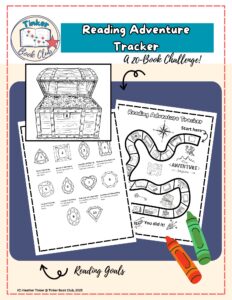
If you’d like to help motivate your kids to reach their reading goals, you can grab my free printable reading tracker.
It’s simple, kid-friendly, and perfect for any reading level.👇
When Extras Can Add Joy (But Aren't Required)
Some homeschool groups enjoy adding extra elements to their kids book club, especially if they meet regularly or have a group of children who love imaginative play.
Optional additions might include:
- Simple themed snacks
- Story-inspired games
- Drawing or watercolor activities
- Building a setting from blocks or loose parts
These extras can be delightful, but they should always support the story, not replace it.
The heart of the book club remains the same: children gathering around a good book and talking about it together.
Helping Children Become Lifelong Readers
One of the quiet goals of a kids book club is helping children develop a lasting relationship with books.
When children experience stories through narration, conversation, and imagination, they begin to see reading as something meaningful. Book club comes to mean community and not just another assignment to complete.
Over time, these simple book club conversations help children learn how to:
- Think critically about stories
- Listen respectfully to others
- Express ideas clearly
- Appreciate the richness of classic literature
And those habits will serve them far beyond childhood.
The True Heart of a Kids Book Club
At Tinker Book Club, we believe that the most meaningful kids book club experiences don’t come from elaborate plans or complicated curriculum.
They come from something much simpler.
A good book.
A group of curious children.
And the space to narrate, wonder, and imagine together.
When those elements are present, a book club becomes more than a reading activity. It becomes a place where stories shape hearts, minds, and friendships.
An Invitation
If you’re building or refining a homeschool book club centered on classic books, discussion doesn’t have to feel complicated or scripted.
At Tinker Book Club, I share tools, prompts, and ideas to help you lead thoughtful, low-pressure books discussions that honor both literature and childhood.
If you’d like more resources like these (discussion prompts, book club structures, and classic-book centered learning ideas) I’d love to invite you to join my newsletter.
Sign up to receive bookish encouragement, seasonal ideas, and practical support for running a meaningful kids’ book club at home. 👇

If you enjoyed this post, you might also like 👉 How to Run a Fairy Tale Book Club for Homeschool (Using Classic Stories Kids Love)
Thanks for listening, friends!